
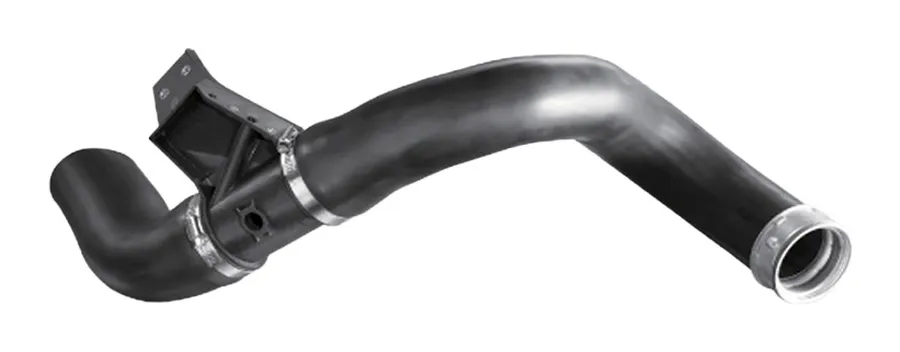
The short answer
Most coolant hoses fail from the inside, through a process called electrochemical degradation, so a hose can look sound and still be close to failing. The practical check is the squeeze test on a cool engine: near the clamps a good hose feels firm but pliant, a failing one feels soft or mushy. Cracks, bulges, a hardened glassy surface, oil contamination and coolant tracks near the connections are the visible warning signs.
How a hose fails from the inside
The hose, the coolant and the metal fittings of the engine and radiator form a weak galvanic cell. The resulting electrochemical attack on the inner tube of the hose produces fine cracks in the tube wall. Coolant seeps through those cracks and attacks the reinforcement of the hose as it wicks along its length. This is electrochemical degradation, usually shortened to ECD.
The damage is concentrated near the ends of the hose, not in the middle, and is most severe where the temperature is highest and air is present with the coolant. That is why the upper radiator hose tends to fail before any other.
The squeeze test
- Let the engine cool completely. Never open or squeeze the cooling system hot.
- Squeeze the hose between thumb and forefinger near each clamp, where ECD most often occurs.
- Compare the ends with the middle of the hose.
A good hose has a firm yet pliant feel along its whole length. Soft or mushy spots near the ends, or gaps and channels that can be felt in the wall, mean the hose is weakening from the inside and should be replaced.
Visible warning signs
| Sign | Likely cause |
|---|---|
| Cracks, nicks or a collapsed section | Age and mechanical damage |
| Bulges, usually visible while the hose is hot | The reinforcement has failed |
| Parallel cracks around bends | Ozone |
| A hardened, glassy surface | Heat damage |
| Oil on the hose | Oil contamination, which attacks the rubber |
| Wear marks where the hose touches another part | Abrasion: the hose is rubbing |
| Fraying near the connection points | The end of the hose is breaking up |
| White, light green, blue or pink tracks in the engine bay | Dried residue of leaking coolant |
A coolant level that keeps dropping in the recovery tank points to a leak even when no track is visible.
When to replace
Consumer Reports recommends replacing all coolant hoses at least every four years, or when one fails, because hoses of the same age have lived in the same conditions. Vehicles used mainly in stop-and-go traffic are harder on their hoses and deserve earlier attention.
Choosing the replacement
A coolant hose is moulded to its route through the engine bay, so it is identified by the OE reference number of the original part, not by diameter and length. Note that number and the vehicle identification number (VIN). Trade customers can request the matching DYNTEK reference and OE cross-references by email.
Related products: radiator hoses and the other DYNTEK hoses.